
Through all of the Kavanaugh news, many important headlines are being washed away in media. A major headline being disregarded is how the Big Four– the biggest accounting companies– are slowly shifting their focus into legal services. This is putting major law firms like Morgan and Lewis, on edge.
To further examine this topic, I read “Should BigLaw firms worry about increasing competition from the Big Four accounting firms?” by Jason Tashea, published by the ABA Journal. This article was about how The Big Four accounting firms have added legal services, moving beyond tax law and integrating their legal services into a multidisciplinary approach.
The BigFour include Deloitte & Touche, Ernst & Young, KPMG and PwC.

Deloitte provides audit, tax, consulting, enterprise risk and financial advisory services with more than 286,200 professionals globally. In FY 2018, the network earned a record $43.2 billion USD in aggregate revenues (Forbes).
Ernst & Young provides audit, tax, business risk, technology and security risk services, and human capital services worldwide. Its network earned $29.6 billion USD in aggregate revenues. Today the company employs over 200,000 people and operates in over 150 countries (Forbes).
KMPG’s network earned $26.40 billion in revenues with over 197,263 employees.
PwC’s network earned $37.7 billion in revenues with over 236,000 employes. 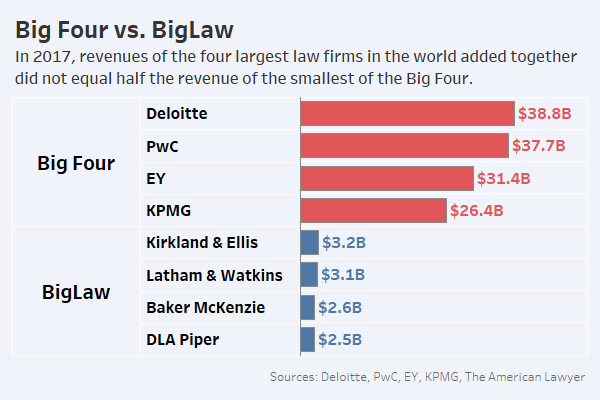
Needless to say, they are called BigFour for a reason.
Tashea anaylizes how law firm leaders are already losing business to this latest source of competition that McKeon is speaking about—and many more are concerned that this could be just the tip of the iceberg. Due to complementary consulting services, which include technology and process improvement, the Big Four have the capacity to make their legal arms more agile than most, if not all, law firms.
“They tell us they’re not practicing law; they’re offering environmental or tax services. They’re offering litigation support services and all kinds of other services,” she said at the debate and confirmed by email. “And the bar does not have any means to assure that the lawyers at the Big Four comply with any of the ethics regulations and/or core values” of the profession.
However, this is not the first time the major accounting firms have tried their hand at practicing law. The Big five spent the 1990s building law firms in a traditional vein. By 2001, KPMG and PwC were the eighth- and ninth-biggest legal services providers by number of lawyers, respectively, according to the Harvard Law School Center on the Legal Profession. The aggressive growth has made Big Four legal departments among the top-10 firms by revenue in France, Italy, Russia and Spain.
How are major law firms like Morgan and Lewis combating this problem? To remain competitive, they have expanded internationally, including in China, and has ramped up its eData services, a discovery and data management program that combines legal and tech professionals.
“We remained focused on offering elite service and building strong relationships with clients who trust us to know their business and give them legal advice in the broad array of areas where they need us,” Morgan Lewis chair McKeon says. “That has been the approach that has made us successful, and the existence of new and different competitors has not changed that.”
Before now, I never really understood the world of corporate law. I thought it was a “world of busy work at a cubicle.” Reading news stories like these, I realized corporate law is a world of excitement. Competing with not just different law, but different companies all together, seems fascinating to me. It is sad how these important stories are in the shadow of politics. The whole Kavanaugh scandal has been clouding up media outlets and as not given importance to topics that deserve attention.
 The Legal Mind