
Kids are known to think impulsively, in which they think their decision is the best decision for them; however, their decision results in a lifetime of regret and tears. Drugs, violence, and gangs are often the life these kids are forced to take part in. These kids are too young to be put in the adult criminal justice system.
To further examine the topic of Juveniles in the adult criminal system, I looked at the article “Why It Makes Sense to Raise the Age of Juvenile Courts?” by R.W, published by the Economist. This article summarizes how the federal government needs to raise the age to admit young people into the adult criminal justice system.
R.W used the story of Ralph Bonano, a juvenile delinquent, as an example. He stated how Ralph dropped out of school, joined a gang, been arrested several times–and he regularly sold drugs. However, thanks to a program he credited called ROCA, he stayed out of trouble. ROCA specializes in helping young people between ages 17 and 25 to stay out of jail and find work. R.W uses this story to highlight how juveniles can turn their life around– that it is not too late to get a second chance. But if Ralph was locked in an adult cell for the rest of his life, he could have never gotten that second chance.
Three academics at Harvard Kennedy School– Vincenet Shiraldi, Bruce Western, and Kendra Bradner wrote a paper recommending that “the age of juvenile court justice be raised to at least 21 years old with additional, gradually diminishing protections for young adults up to age 24 or 25.” They point out that neurobiological and developmental research has shown that the human brain continues to develop into the med 20-especially in the region of the brain which regulates control and reasoning.
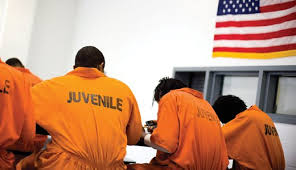
According to the Harvard paper, nearly 130,000 people of age between 18 and 24 were admitted to state and federal prisons in 2012, constituting 21% of all admissions. Most are African-American. The rate of incarceration was more than nine times higher for black men age 18 to 19 than for white men of the same age.
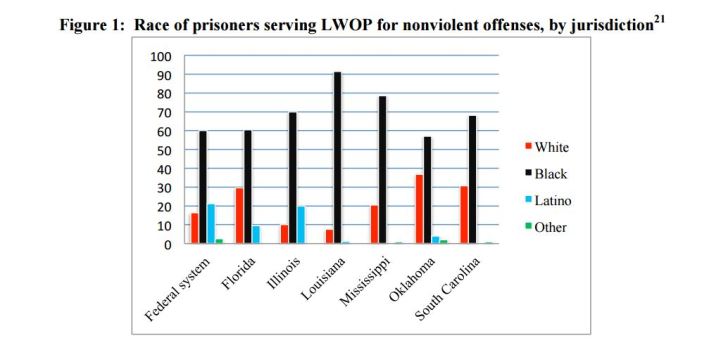
Unfortunately, this problem resembles a previous issue that I identified– Police Brutality and Structural Racism.
One quote from that topic that is similar to the issue at hand is, “the problem of police killings of unarmed black victims should not be viewed merely as a problem of flawed action on the part of individual police officers, but more as a consequence of the broader problem of structural racism,” said senior author Michael Siegel, professor of community health sciences at BUSPH. In both topics, there is a great racial disparity between white victims and black victims. As you can see from the graph, in the federal court juvenile system, 60,000 of the convicted are black and 40,000 of the convicted are white. Does this correlate into police brutality?
How is the government trying to combat this problem? The Justice Centre points to ROCA as an excelled intervention model to help young adults. This program offers transitional employment, life skills development, as well as help with education.
But is this enough?
The answer is no. I personally do agree with author in which we need to raise the age of the adult criminal justice system. These kids act impulsively and are often in need of a second chance. Most of the time, they are forced into these circumstances of violence and do not have a way out. The story of Ralph Bonano proves how a kid can grow and learn from their mistakes, if they are given the chance. ROCA and other like-minded programs offer this second chance, but there are only so many programs.
We need a policy to raise the age of the adult criminal justice system. The author created this article to highlight key values such as, sympathy and justice. Reading the stories of these kids going through the adult criminal system brings me to tears. I could never imagine living a life like that. Most of the time, these kids do not have a voice– which is why we as citizens must take action into our own hands, to be their voice. I hope that more people will open their eyes to the evil going on in the world, because the first step to fight the evil is to talk about it.
 The Legal Mind
Himani, your response is well-worded and your passion for this issue comes through, and it’s excellent that you propose a solution.
The next step is a synthesis paragraph, like we discussed in class. Combine this week’s source with a different week to address how your understanding of a particular issue, or of the topic as a whole, is growing. What patterns or recurrent issues are you noticing?
LikeLike